

Your Home Is Shaping Your Brain — Whether You Designed It That Way or Not
The emerging science of neuroarchitecture shows that ceiling height, fractal geometry, light spectrum, and spatial organization produce measurable changes in cortisol, cognitive function, and emotional regulation. Here is what that means for the rooms you live in.
Architecture shapes the mind. This is not a metaphor — it is a neurological fact increasingly supported by research in environmental psychology, cognitive neuroscience, and the field of neuroarchitecture. The spaces we inhabit influence cognitive function, emotional regulation, memory, attention, and stress physiology in ways that can now be quantified. The home is not a neutral container for your life. It is an active participant in it.
Ceiling Height and the Two Modes of Thinking
One of the most replicated findings in environmental psychology is the ceiling height effect: high ceilings promote abstract, expansive, and creative thinking; low ceilings promote focused, detail-oriented, analytical thinking. This effect operates through cognitive priming — high ceilings activate neural associations with freedom and open space, which in turn bias the brain toward global processing. Low ceilings activate confinement associations, biasing toward local, precise processing.
The practical application is not that one is better than the other — it is that different cognitive tasks benefit from different ceiling environments. Creative work, problem-solving, and strategic thinking are measurably better supported in high-ceilinged spaces. Detailed analytical work, focused reading, and precision tasks are better supported in lower-ceilinged rooms. If your home office has an eight-foot ceiling and you do your best creative thinking there, you may be fighting your environment. A room with twelve-foot ceilings for open-ended thinking and a lower, enclosed nook for focused execution is not interior design preference — it is cognitive ergonomics.
The Fractal Dimension: Nature’s Specific Frequency
This is the finding that most people have never encountered, and it is one of the most consequential in neuroarchitecture. Fractals are patterns that repeat at progressively finer scales — the branching of trees, the structure of ferns, the geometry of clouds. Every fractal has a measurable complexity value called its fractal dimension (D), which runs from 1 (a straight line) to 2 (a completely filled plane).
Research led by physicist Richard Taylor at the University of Oregon found that the human stress response is specifically calibrated to mid-range fractal complexity. Patterns with a fractal dimension between 1.3 and 1.5 — the range that characterizes most natural environments, from forest silhouettes to river networks — reduce physiological stress markers including skin conductance, heart rate, and cortisol. Patterns with either lower complexity (D = 1.2, simple geometric lines) or higher complexity (D = 1.8, dense visual chaos) produce measurably greater stress. A 2025 study using immersive virtual interiors confirmed that mid-range fractals were most effective at both reducing stress during a stressor and accelerating physiological recovery afterward.
The mechanism appears to be physiological resonance: the fractal structure of the human visual system itself — the branching of retinal blood vessels, the dendritic architecture of visual cortex neurons — matches mid-range fractal geometry. When the eye encounters a pattern that matches its own structural frequency, visual processing becomes effortless. The result is stress reduction of up to 60% measured by skin conductance — and the brain detects fractal patterns within 50 milliseconds, before conscious recognition occurs.
“Mid-range fractal patterns — D value between 1.3 and 1.5 — reduce physiological stress by up to 60%. The brain detects them in 50 milliseconds, before you consciously register what you are looking at.”
— Taylor et al., University of Oregon
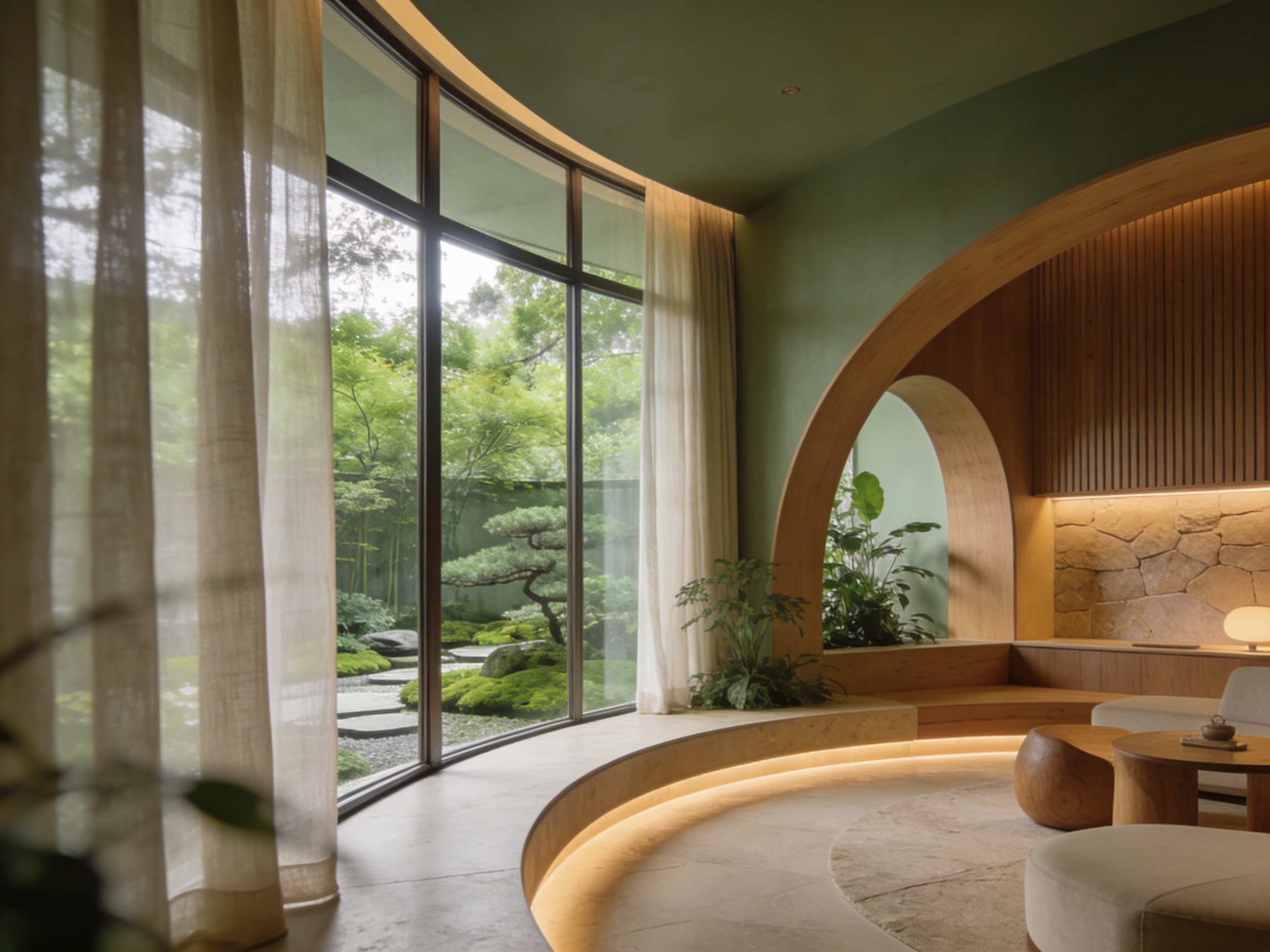
The architectural implication is direct: rooms dominated by flat, unornamented surfaces and geometric right angles — the dominant aesthetic of modern minimalist interiors — are the furthest possible environment from the fractal geometry the human visual system evolved to process. They are not neurologically neutral. They are actively more stressful to be in than spaces that incorporate natural materials, organic patterns, wood grain, stone texture, woven textiles, or living plants — all of which have mid-range fractal dimensions.
Light: The Circadian Architect
Light is the primary signal that sets and maintains the human circadian clock — the 24-hour biological rhythm that governs sleep, cortisol release, immune function, cellular repair, and metabolic regulation. The mechanism runs through specialized photoreceptors in the retina called intrinsically photosensitive retinal ganglion cells (ipRGCs), which are maximally sensitive to short-wavelength blue light at approximately 480nm. Morning exposure to high-intensity, blue-enriched light suppresses melatonin and elevates cortisol, establishing the hormonal arc of the waking day. Evening exposure to the same spectrum at the wrong time disrupts the melatonin onset that initiates sleep and cellular repair.
The problem in modern homes is temporal mismatch: most lighting fixtures produce the same spectrum at 8am and 10pm, offering the brain no environmental signal that the day has ended. LED overhead lighting — which now dominates residential construction — typically produces color temperatures of 3000–5000K. Biological melatonin suppression becomes significant above 2700K. The ceiling lights in most American living rooms and kitchens are biologically indistinguishable from daylight to the circadian system — regardless of how dim you set them.
The solution is not simply dimming; it is spectrum shift. Evening lighting should move below 2700K and transition to amber and red-dominant sources (candles, incandescent-equivalent bulbs, red-spectrum lamps) after approximately 8pm. Morning light should be as bright and blue-rich as possible — ideally within 30 minutes of waking, from natural sunlight or a 10,000 lux light therapy panel placed at eye level.
Spatial Memory and Cognitive Load
The architectural layout of a home influences how the brain navigates it — and navigation is not a trivial cognitive task. The hippocampus, the brain structure most associated with spatial memory and navigation, is also central to declarative memory formation, emotional regulation, and stress response modulation. Environments that impose continuous wayfinding demands — confusing layouts, visual sameness across spaces, lack of distinct spatial identity in each room — create low-level hippocampal activation that competes with the cognitive resources available for the activities you are actually trying to do.
Predictable, legible spatial sequences where you always know where you are and how spaces connect reduce cognitive load and free hippocampal resources for memory consolidation and emotional processing. For aging-in-place design specifically, this has measurable implications: homes with clear spatial hierarchy, contrasting room characters, and strong wayfinding cues support cognitive function longer into age than visually and spatially homogeneous environments.
Acoustic Environment and the Default Mode Network
The default mode network (DMN) — the brain’s resting-state system, active during reflection, creativity, memory consolidation, and self-referential thinking — requires low cognitive noise to activate fully. Continuous low-level sound, even at volumes below conscious annoyance, maintains a mild state of auditory alertness that suppresses DMN activation. This is the neurological mechanism behind the common experience of feeling unable to think deeply in a noisy environment even when the noise is not loud enough to be distracting.
Hard, parallel surfaces — the signature of modern open-plan spaces with polished concrete floors, glass walls, and minimal soft furnishings — create reverberation that extends sound duration and increases ambient noise load. Soft furnishings, textiles, bookshelves, plants, and irregular surfaces absorb and diffuse sound, reducing reverberation and lowering the ambient acoustic burden on the auditory cortex. A room that feels calm is often a room that sounds calm — and the two are not coincidental.
- Switch all lighting above 2700K to amber-spectrum bulbs in living spaces used after 7pm. This single change begins restoring circadian melatonin onset within days. Bedside lamps, living room floor lamps, and kitchen pendants are the highest-priority fixtures — the ones you use closest to sleep.
- Introduce mid-range fractal complexity through natural materials, not decoration. Wood grain, stone, woven textiles, living plants, and unpainted brick all have fractal dimensions in the 1.3–1.5 range. These are not aesthetic choices — they are measurable physiological inputs. A room with exposed wood beams and a linen sofa is neurologically quieter than the same room in painted drywall and polyester upholstery.
- Create at least one high-ceiling space for creative work. If your home has variable ceiling heights across rooms, assign your highest-ceilinged room to the cognitive tasks that benefit most from expansive thinking — brainstorming, planning, creative projects. Reserve enclosed, lower-ceilinged spaces for focused execution work.
- Add soft surfaces to rooms that feel acoustically harsh. A large area rug, a bookshelf on a bare wall, heavy curtains, and upholstered seating collectively reduce reverberation time significantly. If conversations in a room sound slightly echoey, the acoustic environment is adding cognitive load to every hour spent there.
- Make each room spatially distinct. The hippocampus responds to spatial variation — rooms with clear individual character (distinct color, material, ceiling height, or spatial form) are processed with less ongoing cognitive effort than visually homogeneous spaces. Distinct rooms free neural resources for the activities you actually want to be doing in them.
The most consequential insight in neuroarchitecture is also the most counterintuitive: the brain does not distinguish between “home” and “environment.” It is continuously reading the space it is in and adjusting its hormonal, cognitive, and emotional state accordingly — whether you are conscious of that process or not. The question is not whether your home is affecting your brain. It is whether it is affecting it in the direction you want.
If mid-range fractal geometry reduces stress by up to 60% — and your walls are flat painted drywall — what would one natural material change in your most-used room actually do for you?