
Therapeutic Spaces · House Remedy
Red light therapy has moved from sports medicine clinics and dermatology offices into the home wellness space faster than almost any other modality — and faster, in some cases, than the public’s understanding of what it actually does and does not do. The research is genuinely compelling in specific applications. It is also frequently overstated in others. This is what the evidence actually supports.
The Mechanism: Why Red and Near-Infrared Light Are Different
Red light therapy — also called photobiomodulation — works through a mechanism that is meaningfully different from most wellness interventions. The primary target is cytochrome c oxidase, the terminal enzyme in the mitochondrial electron transport chain — the cellular machinery responsible for producing ATP, the body’s energy currency. Red and near-infrared wavelengths (typically 630 to 850 nanometers) are absorbed by cytochrome c oxidase and appear to temporarily dissociate nitric oxide from the enzyme, restoring its function when it has been inhibited by metabolic stress.
The result is measurable: increased ATP production in treated cells, reduced oxidative stress markers, and downstream effects on inflammation and cellular repair. This is not a placebo mechanism. It has been replicated in cell culture, animal models, and human clinical trials across multiple independent research groups. The question is not whether photobiomodulation works at the cellular level — it does — but which specific clinical outcomes that cellular effect translates to at doses achievable in a home device.
What the Research Actually Supports
The strongest evidence for red light therapy falls into three categories.
Wound healing and skin repair is the most robustly supported application. Multiple randomized controlled trials document accelerated wound closure, reduced scar formation, and improved collagen synthesis with red and near-infrared light exposure. The mechanism — increased fibroblast activity and ATP availability — is well characterized. Dermatological applications including acne, psoriasis, and photoaging have produced consistent positive results across multiple trial designs.
Musculoskeletal recovery has strong support in athletic and physical therapy research. Studies published in journals including Lasers in Medical Science and Photomedicine and Laser Surgery document reduced delayed onset muscle soreness, faster return to performance, and reduced markers of exercise-induced inflammation with pre- and post-exercise red light exposure. The effect sizes are modest but consistent.
Neurological and cognitive applications represent the most exciting emerging research area. Transcranial photobiomodulation — applying near-infrared light to the skull — has shown preliminary positive results in traumatic brain injury recovery, Alzheimer’s disease models, and depression. The mechanism involves mitochondrial support in neural tissue and modulation of cerebral blood flow. This research is early but the mechanistic plausibility is high — neural tissue is densely mitochondrial and particularly responsive to photobiomodulation.
What Is Overstated and What to Ignore
Claims around systemic hormonal effects — testosterone increases, growth hormone release — are based on small, often industry-funded studies that have not replicated reliably. Claims that red light reverses aging in any global sense are extrapolations from cellular research that has not translated to clinical outcomes at that scale. If a device claims to treat everything, it is treating nothing with sufficient specificity to be useful.
The key parameters that determine efficacy are wavelength, power density (irradiance), and total energy delivered (dose). Consumer devices vary enormously on all three. A panel with insufficient irradiance at the correct wavelength will produce negligible effect regardless of exposure duration. The minimum effective irradiance at the treatment surface is generally considered to be around 20 mW/cm², and most research protocols deliver between 30 and 60 mW/cm². Many consumer devices do not publish their irradiance data — which should itself be a signal.
Designing Red Light Into Your Home
The most important design decision is placement relative to your daily routine. A red light panel used consistently at low dose outperforms an expensive panel used sporadically. The common failure mode is purchasing a large panel that lives in a room you do not regularly occupy.
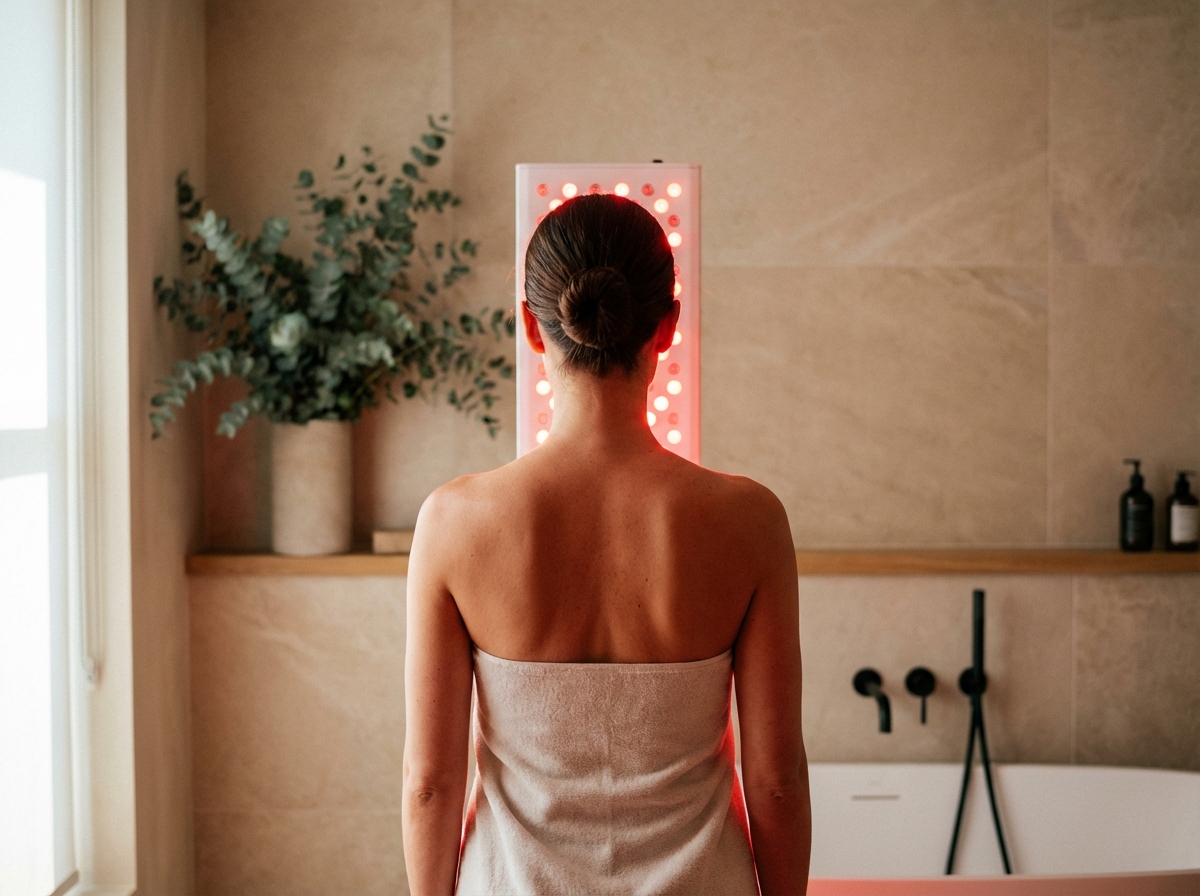
The most effective home placements are adjacent to the shower or bathroom — used during the morning routine before or after washing — or in a dedicated recovery space paired with a cold plunge or sauna. Exposure sessions of ten to twenty minutes at appropriate irradiance produce measurable outcomes in skin and musculoskeletal applications. Full-body panels offer broader coverage but require dedicated space and careful mounting to achieve optimal distance — typically six to twelve inches from the treatment area.
Near-infrared wavelengths penetrate tissue more deeply than red and are preferable for musculoskeletal and neurological applications. Red wavelengths are more effective for superficial skin applications. The best panels deliver both simultaneously. Look for independent third-party testing of irradiance values rather than relying on manufacturer specifications alone.
Where to start
- Define your primary application before purchasing. Skin repair and wound healing need red wavelengths (630-660nm). Musculoskeletal recovery and deeper tissue applications need near-infrared (810-850nm). The best devices deliver both. Buy for your specific use case, not for general wellness.
- Verify irradiance specifications from an independent source. The minimum effective dose at the treatment surface is approximately 20 mW/cm². Many manufacturers publish peak values measured at the panel face — not at the six to twelve inch treatment distance where irradiance drops significantly.
- Position the panel adjacent to your existing morning routine. Consistency at lower dose outperforms occasional sessions at higher dose. A panel mounted in or near the bathroom used for ten minutes during your morning routine will produce better outcomes than a studio panel used twice a week.
- Start with ten to fifteen minute sessions at the recommended distance. More is not better — photobiomodulation follows a biphasic dose-response curve where excessive exposure can negate the benefit. Follow the protocol for your specific device.
- Combine with your sauna or cold plunge sequence if you have one — red light pre-sauna or post-cold-plunge integrates naturally and compounds the mitochondrial and recovery effects of each modality.
Red light therapy is one of the better-supported home wellness modalities when applied to the right applications at sufficient dose. The research on skin, musculoskeletal recovery, and emerging neurological applications is worth taking seriously. The research on everything else requires more skepticism. Used consistently at appropriate parameters, a quality panel positioned within your daily routine is a genuinely useful addition to a home designed around health — not a luxury, but not a replacement for the foundational environmental decisions that matter more.
Are you currently using red light therapy — and if so, what outcomes have you actually noticed versus what you expected?