

OILS & HERBS · House Remedy
Jojoba is not an oil. It is a liquid wax ester — and that distinction is not semantic. It is the reason jojoba behaves differently on skin than every true oil in your cabinet, and it is the key to understanding why it has earned a reputation that most skincare ingredients cannot support with actual chemistry.
The jojoba plant, Simmondsia chinensis, is a desert shrub native to the Sonoran Desert of the American Southwest. What we call jojoba oil is extracted from the seed and composed of approximately 97 to 98 percent wax esters — long-chain fatty acids bonded to long-chain fatty alcohols through an ester linkage. This structure is virtually unique in the plant kingdom. Most plant oils are triglycerides. Jojoba is not. The fatty acid side chains are predominantly monounsaturated — oleic acid, erucic acid, and 11-eicosenoic acid. That single double bond per chain resists oxidation, which is why jojoba has a shelf life of two to three years compared to months for oils like rosehip or flaxseed.
What Human Sebum Actually Is
Before you can understand why jojoba is remarkable, you need a clearer picture of sebum than most skincare content provides. Sebum is not simply “your skin’s oil.” It is a complex, deliberately engineered lipid mixture produced by sebaceous glands — one that changes composition across your lifetime and shifts in response to hormones, temperature, humidity, and the state of your skin barrier.
A standardized synthetic sebum formulation used in research contains roughly 44.7% triglyceride, 25% wax monoester, 17% fatty acids, and 12.4% squalene. That 25% wax monoester fraction is where jojoba enters the picture — structurally most similar to what jojoba provides.
The honest version of the “jojoba mimics sebum” claim is this: jojoba is not a replica of sebum — sebum is far more complex. But jojoba’s wax ester fraction is chemically analogous to the wax ester fraction of sebum, the part that creates the lipid barrier film on your skin’s surface. That partial match is what produces its distinct behavior.
Human sebum’s wax esters are predominantly around C20 in chain length. Jojoba’s dominant esters are C38–C46 — longer chains, structurally related but not identical. The meaningful statement is not that jojoba is a replica of sebum, but that it is the only plant-derived substance that shares sebum’s structural class — and that shared class produces measurable skin compatibility that triglyceride-based oils simply cannot achieve.
The Sebum Feedback Loop
When your sebaceous glands are overproducing oil, it is often because your skin’s surface lipid film is depleted — through over-cleansing, harsh actives, or environmental stripping. The glands receive a signal that the barrier needs reinforcement, and they ramp up production. This is rebound oiliness, and it is one of the most counterproductive cycles in skincare.
Because jojoba’s wax esters are recognized as lipid-compatible molecules, applying jojoba appears to send a competing signal: that sufficient surface lipids are present. A clinical study found that regular application reduced sebum secretion by 23% after 28 days in subjects with oily skin. This bidirectional regulation — calming overproduction in oily skin while supplementing a depleted barrier in dry skin — is something most oils cannot claim with data behind it.
Barrier Repair and Hydration
Jojoba’s wax esters create a semi-occlusive film on the skin surface that reduces transepidermal water loss without fully blocking gas exchange. This is a meaningful distinction from petrolatum-based occlusives, which create a near-total seal. Hydration levels measured by Corneometer increased by 30% within the first 30 minutes of application — but the long-term effect is cumulative barrier repair, not just surface lubrication.
Unlike petrolatum or heavy occlusives, jojoba achieves this without suffocating the skin’s gas exchange. The skin can still breathe. This is a property specific to its wax ester structure — it creates a semi-occlusive film that controls evaporation without blocking the skin’s natural processes.
The Retinol Carrier Effect
This is the piece of the jojoba story that receives almost no attention, and it is arguably the most actionable finding. A pilot study examined whether jojoba could passively enhance the skin penetration of retinol.
The results were striking. Retinol in a standard emulsion without jojoba penetrated the skin membrane with an area under the curve of 7 units over 16 hours. The identical formulation with 10% jojoba added achieved 285 units. That is a nearly 40-fold increase in retinol permeation.
The proposed mechanism: because jojoba’s wax esters mimic the skin’s own lipid structure, they increase the fluidity of the stratum corneum’s lipid matrix — effectively opening microscopic channels that allow fat-soluble actives like retinol to move through more easily. If you use retinol, vitamin C esters, or other lipid-soluble actives, this finding changes how you should be layering them.
How to Use Jojoba — By Skin Type and Goal
Oily and acne-prone skin: Use jojoba as your only moisturizer — 2 to 3 drops pressed into damp skin after cleansing. Its comedogenic rating is zero and its sebum-regulating feedback mechanism actively works against overproduction over 28 days. Do not layer it under heavy creams — it does not need help and heavier products will undermine the result.
Dry and dehydrated skin: Apply 3 to 4 drops to damp skin immediately after cleansing, before any serum or moisturizer. The wax ester layer locks in the hydration from damp skin while the barrier-repairing properties address the underlying deficit. In very dry conditions, layer a ceramide moisturizer over the top.
Aging skin: Apply before retinol — or mix one drop of jojoba into your retinol product directly. The 40-fold increase in retinol permeation means this is not just a comfort measure. It is a delivery mechanism. For vitamin C serums, apply jojoba first to damp skin, allow 60 seconds for absorption, then apply the serum on top.
Sensitive and reactive skin: Jojoba’s structural similarity to sebum means it is among the least-reactive topical oils available. It has a documented history of non-reactivity in patch testing across populations, and its anti-inflammatory phenolic compounds actively reduce rather than provoke skin reactivity. Start with 1 to 2 drops on the face and neck nightly.
Hair and scalp: Massage 4 to 6 drops into the scalp before washing — the wax ester structure allows it to penetrate the follicle opening and dissolve sebum buildup without stripping. Leave on for 20 minutes, then shampoo normally. For dry ends, 1 to 2 drops smoothed through damp ends before styling reduces breakage and frizz without the heaviness of coconut or argan.
What to Look for When Buying
The label should say cold-pressed, unrefined, organic, 100% pure Simmondsia chinensis seed oil. Every word matters.
Cold-pressed means the wax was extracted mechanically without heat, preserving the naturally occurring vitamin E, B-complex vitamins, and phenolic antioxidants that heat processing destroys. Unrefined means it has not been decolorized or deodorized through chemical processes — unrefined jojoba is pale golden with a faint nutty scent. If it is clear and odorless, it has been refined and has lost much of its bioactive content. Organic means the plant was grown without synthetic pesticides or fertilizers. And 100% pure means no carrier oils, fragrances, or fillers have been added.
Avoid any product that lists jojoba as one ingredient among many in a blend — the concentration matters. A product labeled “jojoba oil blend” with sunflower or grapeseed as the base is not delivering the wax ester chemistry that makes jojoba distinctive. You are paying for the structural class, not the word on the label.
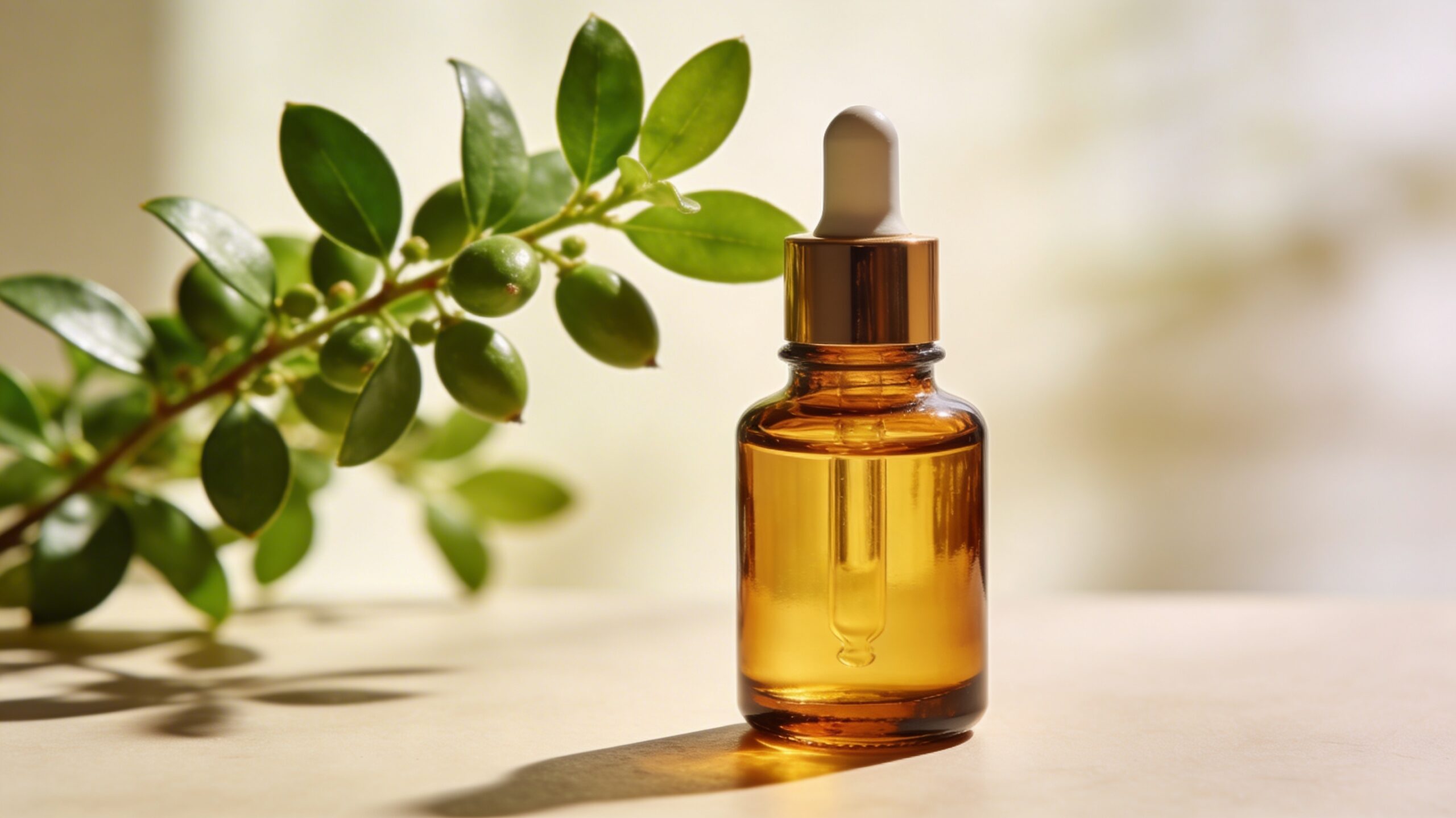
Store it in a dark glass bottle away from direct sunlight. Its natural oxidative stability is excellent — far superior to most plant oils — but light and heat will still degrade it over time. A properly stored bottle of cold-pressed jojoba will last two to three years.
Where To Start
- Choose cold-pressed, unrefined, organic. Pale golden color and a faint nutty scent are the signs of an intact nutrient profile. Clear and odorless means refined and stripped.
- Apply to damp skin after cleansing, before moisturizer. Two to four drops is sufficient for the entire face — jojoba spreads with far less product than true oils require.
- Layer it with retinol or vitamin C for amplified delivery. Mix a drop into your retinol serum or apply immediately before — this is the mechanism working as designed.
- Give it 28 days before evaluating sebum regulation. The 23% reduction in sebum secretion in clinical data emerged at the 28-day mark. Unlike most moisturizing options, jojoba will not clog pores, and its sebum-regulating properties actively work against overproduction rather than sitting neutrally on top of it.
Your skin has been producing wax esters since before you were born — they are part of the fundamental architecture of human skin protection. What jojoba offers is a rare external source of that same structural class, stable enough to store, compatible enough to absorb, and bioactive enough to influence the glands that produce the real thing. That is a narrow description. It is also an accurate one. And in skincare, accurate is better than flattering.
What is your go-to oil?