
WORKPLACE WELLNESS · House Remedy
Healthcare workers — nurses, physicians, respiratory therapists, surgical technicians, medical assistants, and the full range of clinical and support staff who work in hospitals, clinics, and care facilities — face a distinctive occupational exposure profile that is unlike most other professions in an important way: their primary chemical exposures come not from manufacturing or industrial processes but from the very tools used to protect patients. The disinfectants, antimicrobials, sterilization agents, and latex materials that constitute the chemical environment of healthcare work are each individually selected for safety in their intended application. Their cumulative occupational exposure profile is a different matter.
THE DISINFECTANT BURDEN
Healthcare environments use quaternary ammonium compounds, glutaraldehyde, hydrogen peroxide vapor, chlorine-based disinfectants, and alcohol-based hand rubs at concentrations and frequencies dramatically higher than any residential use. Healthcare workers in hospital settings may use alcohol-based hand rub dozens of times per shift, and may be exposed to surface disinfectant aerosols throughout their working environment continuously.
The occupational health consequences of chronic healthcare disinfectant exposure are documented and significant. Studies of nurses have found elevated rates of occupational asthma associated with quaternary ammonium compound exposure — a finding consistent across multiple European and North American cohort studies. A study of over 55,000 US nurses in the Nurses’ Health Study II found that regular use of disinfectants — particularly spray disinfectants and glutaraldehyde — was associated with a 25 to 38% increased risk of COPD diagnosis compared to nurses not regularly using these products.
The skin barrier disruption from frequent hand washing and hand sanitizer use is a distinct and well-characterized occupational concern. Repeated exposure to surfactants and alcohols disrupts the stratum corneum — the protective outer layer of skin — reducing its barrier function, increasing transdermal water loss, and creating the conditions for contact dermatitis that affects an estimated 25 to 35% of healthcare workers at some point in their careers.
WHAT COMES HOME
The primary take-home concern for healthcare workers is not infectious pathogens — the infection control training that healthcare workers receive is effective, and the rate of pathogen transfer from healthcare settings to household contacts through clothing and surface contact is relatively low for most common hospital pathogens. The primary take-home concern is the chemical residue from disinfectant products on clothing and the disrupted skin barrier that carries disinfectant residue on the hands.
The skin microbiome disruption that results from the high-frequency alcohol and antimicrobial use of healthcare work is the less visible but potentially significant home concern. A disrupted skin microbiome carries consequences for immune function and inflammatory regulation that extend beyond the hands — and the transfer of disrupted skin microbiome flora to household surfaces and to household members through contact is a genuine if poorly studied dimension of healthcare occupational exposure.
MITIGATION
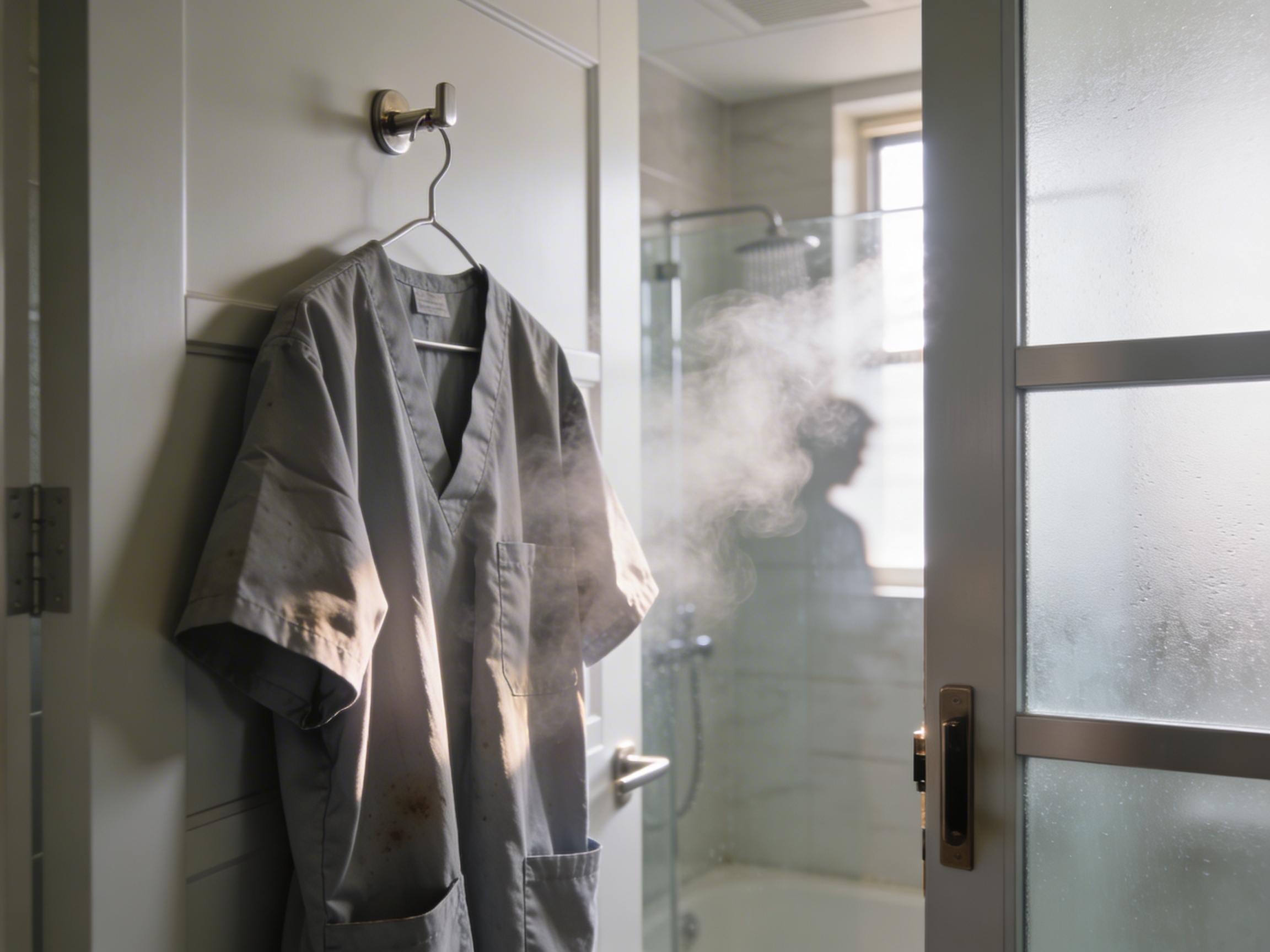
Changing out of scrubs and clinical clothing before leaving the facility, or immediately upon arriving home, eliminates the clothing-mediated transfer route. Most healthcare facilities have clothing change areas, and the practice of not wearing clinical clothing in public or at home is standard infection control guidance that also addresses chemical residue transfer.
Skin barrier restoration is the most important individual health measure for healthcare workers in terms of what affects daily life. A quality emollient applied after hand washing — particularly a ceramide-containing moisturizer that specifically supports stratum corneum repair — restores the barrier function that frequent hand washing and sanitizer use degrades. This is not a cosmetic concern. It is the restoration of a functional biological barrier whose integrity affects immune defense and chemical absorption.
Where to start
- Start small. Pick one actionable tip from this article and apply it this week before moving on to others.
- Audit your current setup. Take stock of what you already have at home that aligns or conflicts with the principles covered here.
- Make one change at a time. Sustainable improvements come from consistent small steps rather than sweeping overhauls.
For the home environment, a HEPA air purifier in common living areas reduces the airborne particulate burden from any clothing that carries particles from the clinical environment. The standard entryway shoes-off protocol applies, and the shower-before-full-household-contact practice is particularly well-suited to healthcare workers returning from shifts.
How have you optimized your home workspace for both productivity and wellbeing?