

WORKPLACE WELLNESS · House Remedy
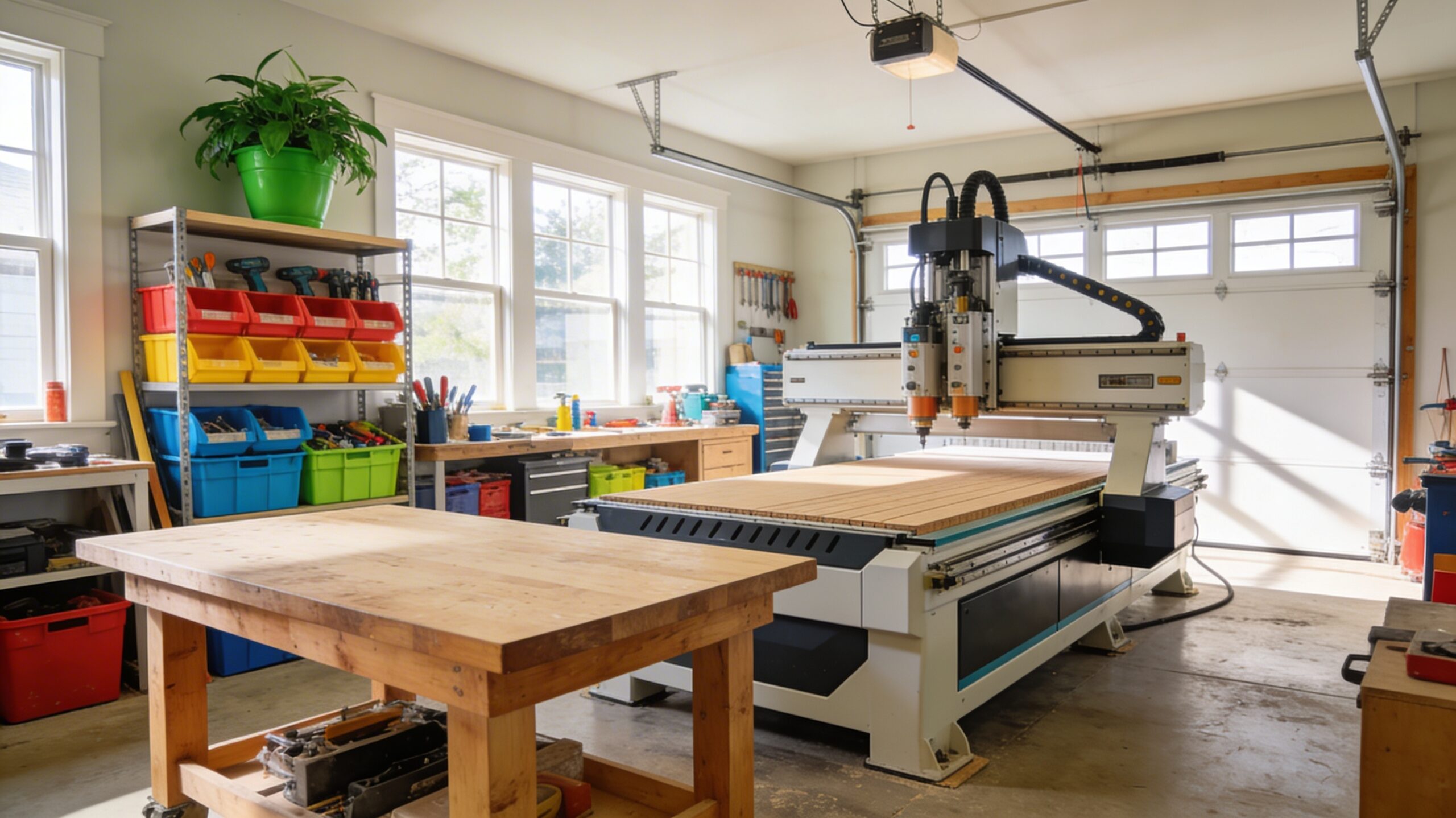
A growing number of Americans are manufacturing products from their garages, basements, and backyard workshops. Equipped with desktop CNC routers, 3D printers, laser cutters, plasma cutters, and resin casting stations, they are designing, producing, and shipping directly to customers — running small manufacturing operations from residential spaces using tools that fit on a workbench and cost less than a used car.
The numbers reflect a real shift. The personal 3D printer market was valued at nearly six billion dollars in 2024, with over thirteen million units in consumer hands. Desktop CNC machines represent a market approaching two and a half billion dollars and growing at almost ten percent annually. Entry-level 3D printers now start under two hundred dollars. The tools that once required a factory floor have become consumer products, and a generation of makers, artisans, and small-batch manufacturers is building businesses without ever stepping inside a traditional facility.
The trend raises a practical question that few people in the space are talking about: what does it take to run these tools safely in a home environment long-term?
What This Shift Looks Like
Walk through any craft market, scroll through Etsy, or visit a local maker space and the evidence is everywhere. Custom furniture built on CNC routers. Jewelry cast in epoxy resin. Laser-engraved signage. 3D-printed prototypes that become production products. Plasma-cut metal art and architectural pieces. These are functioning businesses — many of them profitable, many of them growing, and many of them run by people who taught themselves every step of the process.
What distinguishes this generation of manufacturers is the combination of accessible tools, digital design software, and direct-to-consumer sales channels. A person with a good idea, a garage, and a few thousand dollars in equipment can go from concept to shipped product without a factory, a distributor, or a retail partnership. That is genuinely new, and it is reshaping what small-scale manufacturing looks like in this country.
Setting Up the Shop to Last
Anyone running these tools regularly already knows they produce dust, fumes, and particles — it comes with the work. The question worth asking is whether the workspace is set up to sustain it over years and decades, not just the current project. The solutions are straightforward, and most of them pay for themselves in comfort and productivity.
Every material has a specific profile. Knowing yours is part of being good at what you do.
3D Printing
When thermoplastic filament heats, it releases ultrafine particles and volatile organic compounds. ABS is the heavier emitter — roughly three to four times more particles and VOCs than PLA. Researchers have identified over 200 different VOCs from 3D printing, and residential settings tend to produce higher personal exposure than commercial ones simply because the rooms are smaller and the machine is closer. PLA is the cleaner choice when it works for the application. An enclosed printer with a HEPA filter or a dedicated ventilated space handles the rest.
CNC Routing
Routers and sanders produce the finest dust of any woodworking operation — particles that hang in the air for hours. Wood dust carries a Group 1 carcinogen classification from the International Agency for Research on Cancer, and MDF adds formaldehyde from the binding resins to the mix. The dust from MDF is finer, lingers longer, and is harder to capture than solid wood dust. A proper dust collection system with HEPA-rated canister filters is the backbone of any serious CNC shop. Solid wood or NAUF-certified MDF are better material choices when the application allows.
Laser Cutting
A laser vaporizes material and recombines it into new compounds — so what comes off the cut depends entirely on what is being cut. Acrylic releases VOCs and formaldehyde. Wood produces carbon compounds and species-dependent particulates. The one material that should never go near a laser is PVC — it releases chlorine gas, hydrogen chloride, and dioxins that are acutely toxic and will corrode the machine itself. Most experienced operators know this, but PVC is everywhere in hardware stores and easy to mistake for other plastics. A dedicated exhaust path to the outside — not to an attic or crawlspace — handles most materials well.
Plasma Cutting
Plasma vaporizes metal, and the fume contains metal oxides small enough to absorb through the lungs into the bloodstream. Stainless steel produces hexavalent chromium, a known carcinogen. Galvanized steel releases zinc oxide, which causes metal fume fever. Manganese exposure, common in cutting various steels, can cause neurological symptoms over time. These are the reasons commercial shops invest in downdraft tables and fume extraction — and any home shop running regular plasma work benefits from the same approach. A water table is another effective option that many garage fabricators use.
Resin Casting
Uncured epoxy is an active chemical system. Lower-cost resins often contain non-reactive filler solvents that evaporate into the air during curing rather than bonding into the finished piece — those fillers are the primary source of fumes. Choosing a fully reactive, high-quality resin dramatically reduces exposure. The other thing every resin worker should know is that skin sensitization is cumulative and permanent — repeated bare-skin contact can trigger a lifelong allergic response to all epoxy resins. Nitrile gloves every session, no exceptions. And partially cured resin dust is reactive and significantly more irritating to the lungs than fully cured material — make sure it is fully cured before sanding.
The Essentials for a Shop Built to Last
None of this is complicated, and most experienced makers already have pieces of it in place. The goal is making sure the full picture is covered — because this is a long game, and the shop should support the work for as many years as the business runs.
Where To Start
- Dedicate and separate your shop space. A sealed room, partitioned garage, or outbuilding with its own ventilation path keeps shop air out of your living space. If a 3D printer is currently on a desk in a bedroom, it needs its own zone.
- Exhaust to the outside and filter what stays. A direct exhaust port to the exterior — paired with a HEPA air filtration unit running at least four air changes per hour — handles particulates. Add activated carbon filtration for VOC-producing work like resin, laser cutting, and ABS printing.
- Wear the right respirator. A half-face respirator with P100 particulate filters and organic vapor cartridges is the correct tool. N95 masks do not filter chemical vapors. Dust masks do not stop ultrafine particles. Replace cartridges on schedule.
- Know your materials. Read the Safety Data Sheet for every filament, resin, and sheet stock. Choose PLA over ABS when possible. Use solid wood or NAUF-certified MDF over standard MDF. Never laser-cut PVC. Choose fully reactive resin formulations without filler solvents.
- Measure your air. A handheld VOC meter and a particle counter tell you what your senses cannot — and they cost less than most of the tools in your shop.
The home manufacturing movement is growing because the tools have never been more capable, the market access has never been more direct, and the cost of entry has never been lower. What has not kept pace is the conversation about workspace design — the ventilation, filtration, and protection that let someone do this work sustainably over a career. The tools are ready. The shops should be too.
What mitigations have you put in place for your workspace?