
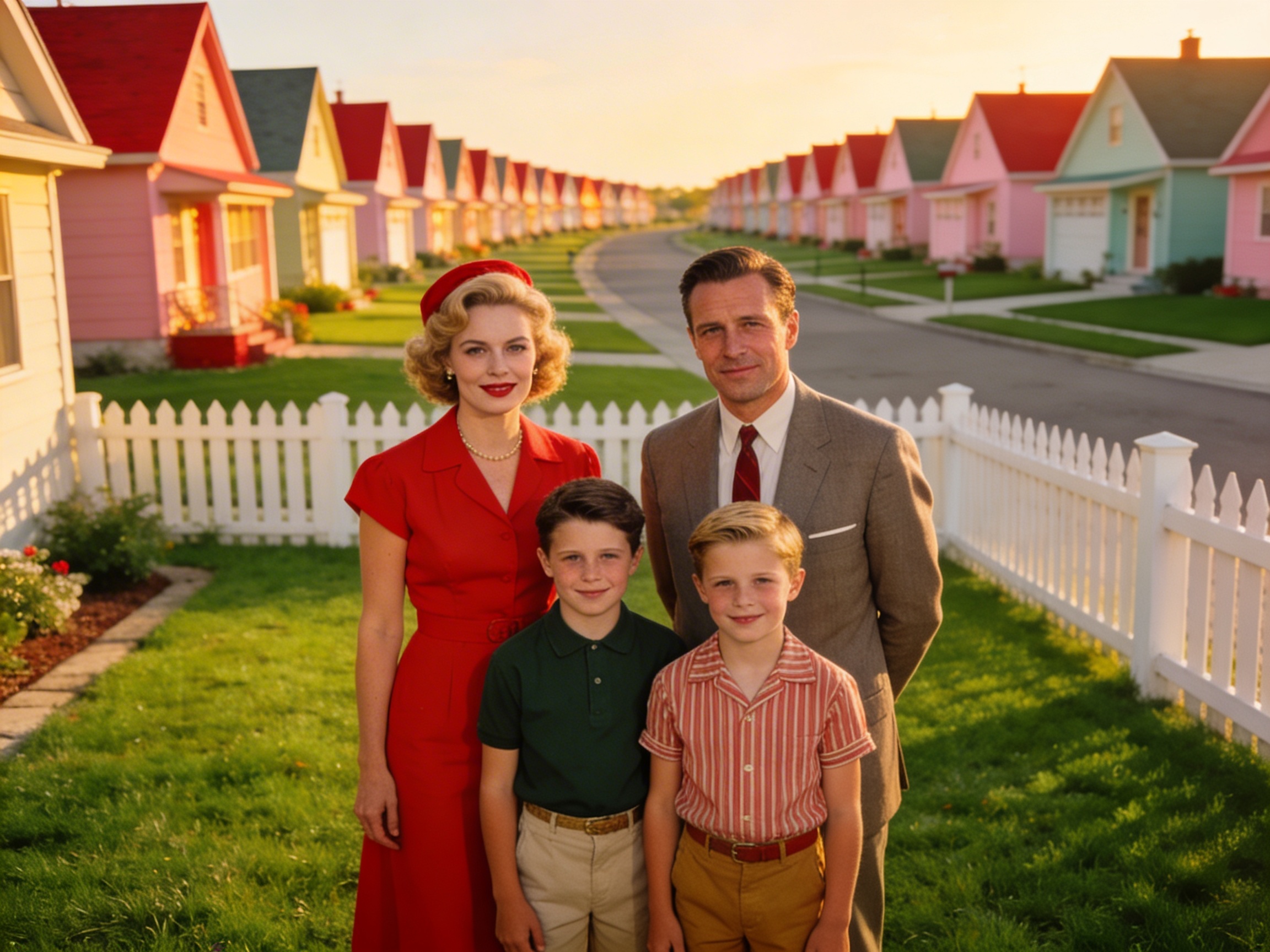

Before we talk about what the American lawn became, it is worth remembering what it was not. For most of human history, the space around a home was functional. It grew food. It raised animals. It composted. It provided herbs for cooking and medicine. The idea of cultivating a large area of short grass — a plant you cannot eat, that produces nothing, that requires constant maintenance — and calling it the ideal landscape would have baffled almost every generation that came before ours.
So how did we get here? The answer involves medieval castles, Scottish sheep, a family of New York real estate developers, a chemical industry looking for a peacetime market, and one of the most successful pieces of consumer marketing in American history.
The lawn started as a military feature
The word “lawn” comes from the Middle English launde, meaning a clearing in the woods. The earliest lawns were the grasslands around medieval castles in France and Britain, kept clear of trees for a practical reason: the guards needed an unobstructed view of anyone approaching. Short grass meant you could see your enemies coming.
Later, the term expanded to include the village commons — shared meadows where residents could graze their sheep and cattle. The animals were the lawn mowers. They kept the grass cropped and fertilized it as they grazed. Nobody maintained these spaces for aesthetics. They were working landscapes.
The ornamental lawn — grass cultivated purely for its appearance — was a luxury of the European aristocracy. It took a staff of groundskeepers with scythes to maintain, which is exactly the point. A manicured lawn said one thing clearly: the owner of this land is wealthy enough to grow nothing useful on it. That was the message. Not beauty. Status.
America imported the idea — and the grass
The grasses that make up the American lawn are not native to North America. Kentucky bluegrass — the most iconic lawn grass — is not from Kentucky. It was brought here from Northern Europe, where the mild, moist climate naturally supports close-cut grasslands. The North American climate, by contrast, is generally too hot, too cold, too dry, or too variable for these grasses to thrive without intervention. Growing a European-style lawn on this continent has always been an uphill ecological battle. That is important context for everything that came next.
Early American homesteads did not have lawns. The area outside the front door was typically packed dirt, or a cottage garden mixing flowers, herbs, and vegetables. Formal gardens modeled after English estates were a luxury for the wealthy — Thomas Jefferson among them — who could afford the labor to maintain them. For everyone else, the yard was either productive or simply wild.
The first American book on lawn care appeared in 1870, written by a Cincinnati landscape architect named Frank J. Scott. He told his readers that a smooth, closely shaven surface of grass was the most essential element of a beautiful property. The idea was planted — but it would take another 75 years and a world war to make it universal.
World War II changed everything
During the war, lawn mowers were melted down for the war effort. Families grew Victory Gardens. The yard was productive again — briefly. Then the war ended, and three things happened almost simultaneously that created the modern American lawn.
First, the suburbs. The GI Bill gave returning servicemen access to home loans with no down payment. The Federal Housing Administration reduced down payments for everyone else. Owning a home suddenly became cheaper than renting. Developers like Abraham Levitt and his sons responded by mass-producing suburban housing at a pace the country had never seen. Between 1947 and 1951, the Levitts built more than 17,000 homes on the potato fields of Long Island — every single one of them with a lawn. Homeowners were required by covenant to mow weekly from April through November. The lawn was not optional. It was part of the deal.
Second, the chemicals. The war had driven enormous investment in chemical research — for explosives, defoliants, and other military applications. When the war ended, those chemical companies needed new markets. The technology that had been directed toward warfare was redirected toward peacetime use, and one of the largest new markets was the residential lawn. Fertilizers, herbicides, and pesticides were packaged for homeowners and marketed as essential tools for achieving the perfect yard.
Third, the marketing. Companies like the Scotts Company of Marysville, Ohio took agricultural chemicals and reformulated them for consumer use. But Scotts understood something important: they were not just selling products. They were selling an ideal. They needed homeowners to believe that a pure, weed-free, uniformly green lawn was the standard — and that anything less was a failure. The marketing worked. By the 1950s, the perfect lawn had become a symbol of suburban success, neighborhood respectability, and the American Dream itself.
The great clover betrayal
Here is the part of this story that most people have never heard. Before the chemical era, clover was a standard and desirable part of every lawn. It was included in grass seed mixes on purpose. Clover is a legume — it fixes nitrogen from the air into the soil, which means it naturally fertilizes the grass growing around it. A lawn with clover stays green with less water, feeds itself, and supports pollinators. It was the original low-maintenance lawn.
Abraham Levitt himself — the man who built America’s most famous suburb — said that clover was “just as nice as other grasses” and warned against becoming a slave to the lawn. He never wanted the perfect monoculture that his developments eventually inspired.
What killed clover was broadleaf herbicide. When chemical companies introduced products that killed “weeds,” those products could not distinguish between a dandelion and a clover plant — both are broadleaf plants. Clover died alongside the weeds. The industry then sold fertilizer to replace the nitrogen that clover had been providing for free. It was a business model of extraordinary elegance: remove the natural solution, then sell the chemical replacement. And it worked so well that within a generation, people forgot that clover had ever been part of a healthy lawn in the first place.
What we are maintaining — and what it costs
Today, American lawns cover approximately 40 million acres — an area nearly the size of Wisconsin. Residential lawns require more irrigation than any agricultural crop grown in the country. The annual spending on lawn care in the United States exceeds $29 billion. Gas-powered mowers, leaf blowers, and trimmers contribute measurably to air pollution. And the herbicides, pesticides, and synthetic fertilizers applied to residential lawns run off into waterways, contaminate groundwater, and create the chemical exposure pathway that is the subject of an entirely separate conversation about children’s health.
All of this — the water, the chemicals, the cost, the labor, the environmental impact — is in service of maintaining a non-native plant that produces nothing, in a climate that does not naturally support it, because a real estate developer in 1947 thought it looked nice and a chemical company in the 1950s figured out how to make money from the difficulty of keeping it alive.
What your yard could be doing instead
The yard around your home is some of the most valuable square footage you own — not in dollars per square foot, but in what it can do for your daily life if you let it. A kitchen garden growing herbs you actually cook with. A few fruit trees that produce food for decades with minimal care. Native plants that support pollinators and require no irrigation or chemical input because they evolved to grow exactly where you live. A patch of clover that feeds the soil, stays green through drought, and feels soft under bare feet.
This is not a radical idea. It is the oldest idea. For most of human history, the land around a home worked for the people who lived there. It fed them. It provided medicine. It composted their waste and returned it as fertility. The ornamental monoculture lawn is the historical anomaly — a brief, expensive, chemically dependent experiment that is less than a century old.
You do not have to tear out your entire lawn tomorrow. But you might start by asking yourself what it is actually giving you — and what it could be giving you instead. A row of blueberry bushes along the fence line. A raised bed of tomatoes and basil where the least-used section of grass used to be. A border of native wildflowers that never needs mowing, never needs watering, and feeds the bees that pollinate your neighbors’ gardens too.
The American lawn was sold to us as a symbol of success. But the most successful yard is one that gives something back — to the people who live there, to the soil beneath it, and to the community around it.
- Stop applying herbicides and let the clover come back. Clover fixes nitrogen, stays green in drought, and was a standard part of lawn seed mixes before the chemical industry removed it. If you overseed with white Dutch clover, it will establish itself within a season and begin feeding your soil naturally.
- Convert one section of lawn to food production. Start with a 4×8-foot raised bed in the area that gets the most sun. Herbs, tomatoes, peppers, and lettuce are easy first crops that will produce more value in one season than that patch of grass produced in a decade.
- Plant native species along borders and edges. Native plants are adapted to your local climate, soil, and rainfall — they require no irrigation, no fertilizer, and no pesticides once established. Your local cooperative extension office can recommend species for your region.
- Replace high-maintenance turf with low-maintenance ground cover. Creeping thyme, clover, or native sedges provide a green surface that requires far less mowing, no chemical input, and supports pollinators. In shaded areas where grass struggles anyway, moss or native ferns are beautiful and maintenance-free.
- If you keep a lawn, build the soil instead of feeding the grass. Aerate annually, top-dress with compost, overseed with climate-appropriate varieties, and mow high — three inches or taller. Healthy soil grows dense turf that resists weeds without chemicals. This is the approach that eliminates the need for the products the lawn care industry has been selling for 70 years.
Your yard is not a stage set. It is a living system — and it can either cost you time, money, and chemicals every week, or it can quietly work alongside you, growing food, supporting life, and improving the soil it sits on. The generation before us was taught that a green lawn was the goal. The generation after us will wonder why we spent so much maintaining something that gave so little back. The good news is that you get to be the one who changes the story.
If you had the space, would you rather have a perfect lawn or a garden that feeds you?