

HISTORY OF THE HOME · House Remedy
The cleaning products under the average American sink represent one of the most dramatic chemical transformations in the history of domestic life — a transformation that occurred almost entirely within the twentieth century, that was driven by forces of industrial chemistry and consumer marketing rather than by documented improvements in health outcomes, and that has produced an indoor air quality situation that would have been unrecognizable to any previous generation of homemakers.
Understanding how we got here requires going back to the beginning.
THE FIRST 10,000 YEARS: ASH, LARD, AND REAL SOAP
For the vast majority of human history, household cleaning was accomplished with a remarkably short list of materials. Ash — specifically the potassium-rich ash from wood fires — was one of the earliest cleaning agents, used both as an abrasive and, when dissolved in water, as a caustic lye solution that cut through grease through saponification. Animal fat combined with lye produced primitive soap — a chemical reaction that has been documented in human settlements going back at least 4,000 years, with the earliest known soap recipe recorded on a Babylonian clay tablet circa 2200 BCE.
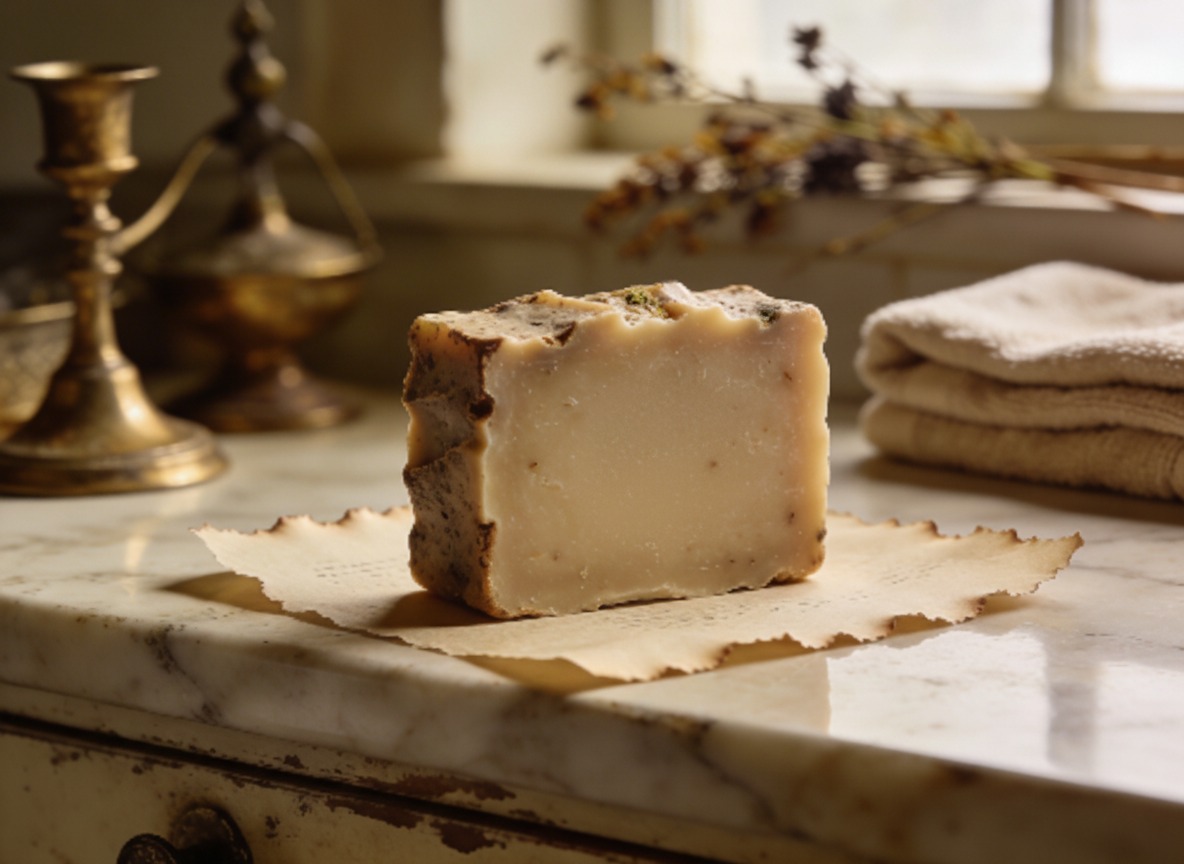
Natural soap remained the primary household cleaning agent for millennia. It is biodegradable, it is made from renewable materials, it produces no VOCs, and in the context of the other household air quality variables of pre-industrial life — wood smoke, animal dander, candle fumes — it added nothing to the chemical complexity of the indoor environment. Its limitation was primarily practical: it performed poorly in hard water, leaving the mineral soap scum that anyone who has cleaned a bathtub with real soap recognizes, and it was labor-intensive to make before the industrial era made commercial soap manufacture economical.
THE LATE 19TH AND EARLY 20TH CENTURY: COMMERCIAL SOAP AND BRAND EMERGENCE
The industrial production of soap in the nineteenth century democratized access to household cleaning and produced the first recognizable consumer cleaning products — Ivory Soap (1879), Borax-based cleaning compounds, and the emergence of branded household products as a commercial category. These early commercial products were still chemically simple by modern standards: soap, borax, washing soda (sodium carbonate), and ammonia were the primary active ingredients, with simple formulations that contained a handful of identifiable compounds.
The marketing of these products introduced something new alongside the chemistry: the idea that cleanliness was a moral virtue associated with specific commercial products, and that the housewife who used the right brand was both a better cleaner and a better person. This cultural association between commercial cleaning products and virtue is the narrative infrastructure on which the subsequent century of product proliferation was built.
WORLD WAR II AND THE SYNTHETIC DETERGENT REVOLUTION
The twentieth century transformation of household cleaning chemistry was triggered by World War II — specifically by the shortage of animal and vegetable fats used in soap production that the wartime economy created. In response, the chemical industry scaled up the production of synthetic detergents — cleaning agents made from petroleum-derived surfactants rather than saponified fats — which had been developed in Germany in the 1910s and 1920s but had not yet achieved significant consumer market penetration.
The synthetic detergents that flooded the consumer market in the postwar years performed better than soap in hard water, worked in cold water, and were significantly cheaper to produce than fat-based soaps. They were also the first cleaning agents in human history to contain compounds that were entirely foreign to the natural environment — petroleum-derived surfactants that biodegraded slowly or not at all, persisting in waterways and producing the famous river foaming events of the 1960s that drove early environmental regulation of surfactant chemistry.
THE FRAGRANCE EXPLOSION: 1950s TO 1980s
The addition of synthetic fragrance to household cleaning products transformed them from functional tools to brand experiences. The “fresh lemon” scent of a kitchen cleaner and the “spring breeze” of a fabric softener were not improvements in cleaning performance — they were consumer triggers, engineered to associate the use of the product with a sensory experience of cleanliness rather than with any measurable cleanliness outcome.
The synthetic fragrance compounds added to cleaning products in this era were largely unstudied for indoor air quality effects. The regulatory framework treated them as generally recognized as safe in their primary use as fragrance — a standard that evaluated acute toxicity rather than chronic low-level indoor inhalation exposure. By the time the VOC and phthalate concerns associated with synthetic fragrance were being characterized in the research literature, the fragrance-in-cleaning-products norm was so thoroughly established that its removal required active effort against consumer expectation.
THE ANTIBACTERIAL ERA: 1990s TO PRESENT
The introduction of antibacterial cleaning products into the mainstream consumer market in the 1990s — primarily driven by the addition of triclosan to dish soaps, hand soaps, and surface cleaners — represented the latest major chemical addition to the household cleaning arsenal. The marketing positioned bacterial presence in the home as a pervasive and serious threat, antibacterial products as the necessary response, and conventional soap as inadequate for the task.
The science did not support this marketing. The FDA, after reviewing the evidence for triclosan’s effectiveness compared to plain soap in consumer settings, found no evidence that antibacterial soaps provided greater protection against infection than ordinary soap and water, and found evidence of endocrine disruption from triclosan that led to its removal from consumer antiseptic products in 2016. The quaternary ammonium compounds that replaced triclosan in many formulations are under similar scrutiny for microbiome disruption effects that their predecessors’ regulatory removal did not prompt their manufacturers to anticipate.
WHERE WE ARE NOW
The cleaning cabinet of 2026 is the accumulated product of a century of chemical addition without corresponding chemical subtraction — each era adding new categories of synthetic compounds without removing the previous era’s additions. The result is a category of household products that is simultaneously among the most familiar, most trusted, and most chemically complex in the modern home.
Where To Start
- Replace your all-purpose cleaner with a 50/50 white vinegar and water spray. This single substitution removes synthetic surfactants, fragrance, and preservatives from your most frequently used cleaning product.
- Read the back label of every cleaning product under your sink. If the ingredient list includes fragrance, quaternary ammonium compounds, or a warning to ventilate — that product is adding chemicals to your indoor air every time you use it.
- Try a full month using only vinegar, baking soda, castile soap, and hydrogen peroxide. The four-ingredient approach handles every surface in the home. After 30 days, evaluate whether you actually need any of the products you set aside.
The return to simpler chemistry — the baking soda, vinegar, castile soap, and hydrogen peroxide that replace most of this accumulated complexity — is not nostalgia for a primitive past. It is the application of what a century of chemistry has taught us: that the cleaning function and the chemical complexity are separable, that the latter was added for commercial rather than functional reasons, and that the home is cleaner in every sense when the two are separated again.
Which household materials or products have you swapped out for healthier alternatives?