

Mind & Emotional Health · House Remedy
Some rooms just feel right the moment you walk in — others, you never quite relax. That difference is not random, and it is not just about how a room looks. It is about how a room works on your mind and your body, and the research behind it is decades deep and remarkably specific.
What follows is not a list of decorating tips. It is an overview of the mechanisms by which the rooms you inhabit are shaping the person who lives inside them — and what the research says you can do about it.
The Doorway Effect: How Your Floor Plan Shapes What You Remember
One of the most fascinating findings in environmental cognition is the doorway effect, documented by Gabriel Radvansky and colleagues at the University of Notre Dame. In a series of experiments — conducted in both virtual and physical environments — subjects who walked through a doorway consistently performed worse on memory tasks than subjects who walked the same distance within a single room. The doorway did not distract them. It erased what they were holding in working memory.
Radvansky’s explanation is elegant: doorways function as event boundaries. The brain uses spatial transitions to segment experience into episodes. When you cross a threshold, your cognitive system files the previous episode and begins constructing a new one. The information you were holding — the reason you got up, the thought you were carrying — belongs to the previous event and becomes harder to retrieve. This is not a failure of memory. It is memory working exactly as designed, optimizing for whatever is relevant in the new environment rather than holding onto what was relevant in the old one.
The implication for home design is significant. A floor plan with many small, compartmentalized rooms creates more event boundaries per hour of living than an open-plan layout. This is neither good nor bad in itself — the question is whether the compartmentalization serves the activity happening inside each room. A dedicated study with a closed door may help you focus precisely because the doorway files away the kitchen conversation you just left. But a home where you constantly walk from room to room to retrieve things you cannot remember wanting may be working against your cognitive flow rather than supporting it.
Clutter and Cortisol: The Stress You Cannot See
Researchers at UCLA’s Center on Everyday Lives of Families conducted one of the most revealing studies on how the physical home environment affects stress physiology. Darby Saxbe and Rena Repetti analyzed linguistic data from self-guided home tours narrated by sixty dual-income couples, then correlated the language with salivary cortisol samples taken over three weekdays. The finding was stark: women who described their homes using words associated with clutter and unfinished projects had significantly flatter diurnal cortisol slopes — a pattern linked to chronic stress, fatigue, and adverse long-term health outcomes. Women who used words associated with restfulness and nature had steeper, healthier cortisol curves. Men in the same households did not show the same pattern.
The mechanism is not simply that clutter is unpleasant to look at. Clutter represents unresolved cognitive tasks. Every visible pile of unsorted mail, every stack of clothes that needs to be put away, every surface that signals undone work — each one occupies a thread of working memory, even when you are not consciously thinking about it. The brain does not fully distinguish between tasks you intend to complete and tasks your environment is passively reminding you exist. The result is a low-grade state of cognitive overload that prevents the nervous system from fully downshifting into restoration, even in the space that is supposed to be your refuge.
This is why a decluttered home does not just look better — it allows cortisol to follow its natural circadian rhythm, peaking in the morning to support wakefulness and declining through the afternoon and evening to allow recovery and sleep. When the home itself is a source of unresolved visual signals, that curve flattens, and the body stays in a state of low-level vigilance that accumulates over weeks and months.
Prospect and Refuge: Why Furniture Placement Is a Nervous System Decision
In 1975, geographer Jay Appleton proposed a theory that has quietly become one of the most influential ideas in environmental psychology: prospect-refuge theory. Appleton argued that humans have a consistent, measurable preference for environments that simultaneously offer an unobstructed view of the surrounding area (prospect) and a protected position from which to observe (refuge). The ideal is a space where you can see without being easily seen — a preference so reliable across cultures and age groups that it appears to be wired directly into the nervous system.
The practical consequence for home design is more immediate than it sounds. Consider where you instinctively sit in a restaurant: most people prefer the seat that faces the door with their back to a wall. This is not a personality quirk. It is prospect-refuge in action — your nervous system selecting the position that maximizes situational awareness and minimizes vulnerability. The same logic applies to every major seating position in your home. A sofa placed with its back to a large window or an open doorway behind it may feel subtly uncomfortable in a way that is difficult to articulate. A reading chair placed in a corner with a view of the room’s entrance will feel like the most natural spot in the house. Neither reaction is about aesthetics. Both are about whether the furniture arrangement is allowing your nervous system to stand down.
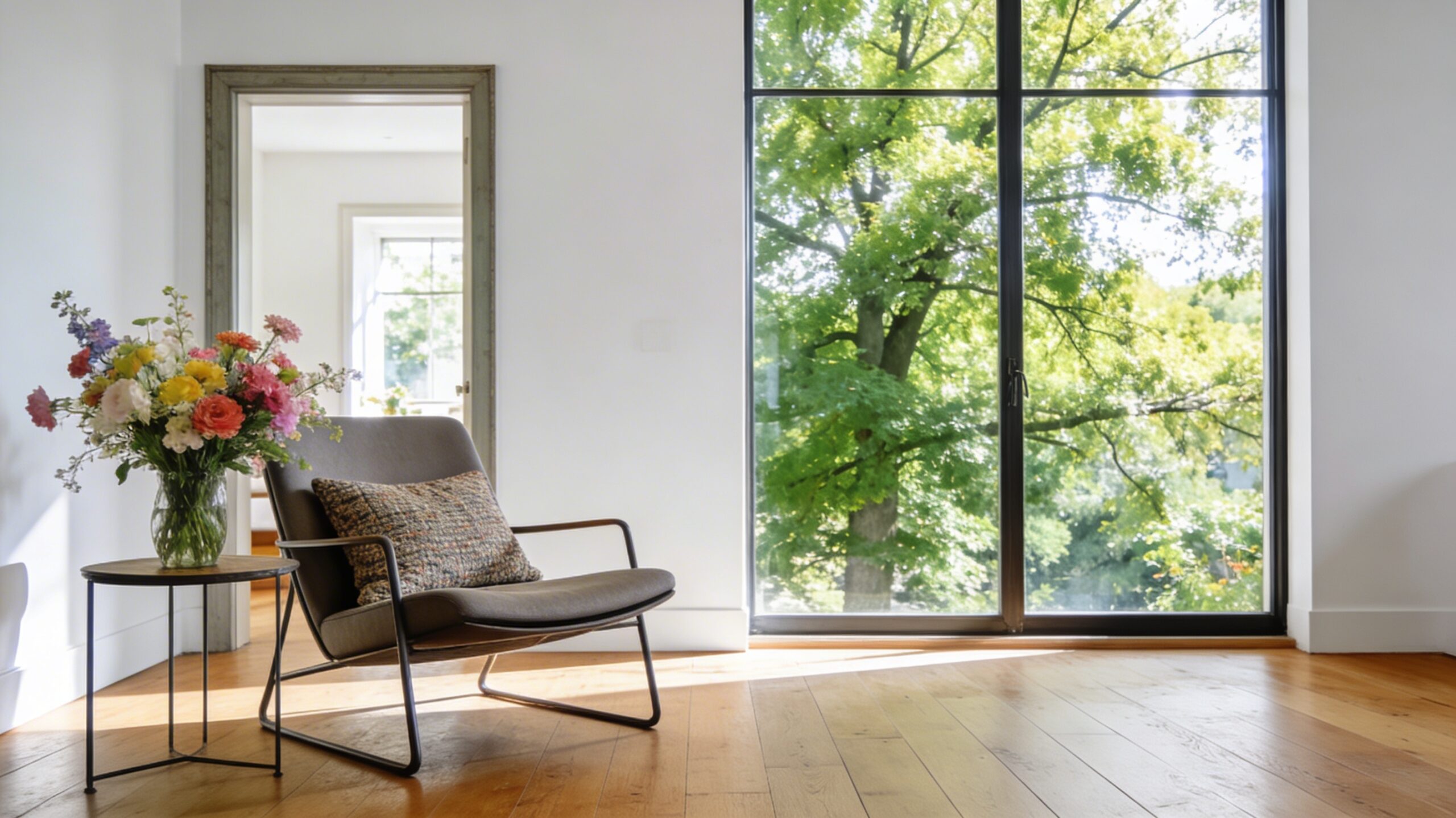
Designing for prospect and refuge does not require architectural changes. It means orienting seating so occupants face toward entries and windows rather than away from them. It means creating at least one space in the home that feels enclosed enough to be protective — a window seat, an alcove, a reading nook with a lowered ceiling or a canopy — while still offering a view outward. The nervous system registers these spatial relationships continuously, and when the arrangement is right, the body can relax in a way that no amount of soft furnishing can replicate.
Ceiling Height and the Two Modes of Thinking
Among the most reliably replicated findings in environmental psychology is the ceiling height effect: rooms with higher ceilings promote abstract, expansive, creative thinking, while rooms with lower ceilings promote focused, detail-oriented, analytical thinking. The research, first documented by Meyers-Levy and Zhu in 2007, showed that participants in rooms with ten-foot ceilings performed better on tasks requiring relational and abstract reasoning, while participants in rooms with eight-foot ceilings performed better on tasks requiring specific, constrained analysis.
The mechanism appears to involve a metaphorical association between physical space and cognitive freedom — what researchers call conceptual priming. A high ceiling unconsciously activates concepts of freedom, openness, and possibility. A low ceiling activates concepts of confinement and specificity. Neither is superior. The question is whether the ceiling height matches the cognitive task most often performed in that room. A living room where conversation and creative thinking happen benefits from height. A home office where concentrated analytical work happens may benefit from a lower, more contained space. Most homes were not designed with this in mind — but understanding it allows you to choose which room serves which purpose, rather than assigning rooms arbitrarily.
Place Identity: The Home as a Mirror of the Self
Since Harold Proshansky introduced the concept of place identity in 1978, environmental psychologists have documented that the places people inhabit do not merely reflect identity — they actively construct it. Place identity is now understood as a substructure of self-identity, functioning alongside categories like gender, social class, and family in shaping how a person understands who they are. The home, as the environment over which an individual exercises the most complete agency, is the most psychologically significant place in that system.
Studies of people in institutional settings — dormitories, hospitals, long-term care facilities — consistently show that the ability to personalize and modify one’s environment is associated with significantly better psychological outcomes than equivalent physical spaces over which no agency is exercised. It is not the quality of the objects in the room that matters most. It is the sense that the occupant chose them, arranged them, and can change them. A home that feels imposed — whether because of a landlord’s restrictions, a partner’s dominance over the shared space, or simply a lack of awareness that the environment can be shaped — is a home that is psychologically less supportive than one in which the occupant feels authorship over the space.
This is one of the reasons that home renovation and redesign can feel disproportionately meaningful. The act of reshaping the built environment is also, in a real psychological sense, the act of reshaping the self. It is an assertion of agency over the most intimate physical space in a person’s life — and the research suggests that the psychological benefits of that agency are not incidental to the design. They are the design.
Color, Light, and the Autonomic Nervous System
The home’s light environment is not a cosmetic concern. Light spectrum and intensity are primary regulators of the circadian system, and the circadian system governs sleep, hormone production, immune function, and mood. Blue-enriched light — the kind emitted by overhead LEDs and screens — suppresses melatonin production through intrinsically photosensitive retinal ganglion cells (ipRGCs) that send signals directly to the suprachiasmatic nucleus, the brain’s master clock. This suppression is useful in the morning, when alertness is the goal. It is actively harmful in the evening, when the body is attempting to transition toward sleep.
Color also acts on the autonomic nervous system through pathways that are not fully conscious. Warm tones — soft reds, terracottas, amber — are associated with parasympathetic activation, the branch of the nervous system responsible for rest, digestion, and recovery. Cool tones — particularly bright whites and blue-whites — are associated with sympathetic activation, the branch responsible for alertness and stress response. A home that is uniformly lit in cool white throughout the evening is keeping the sympathetic nervous system engaged precisely when it should be disengaging. The remedy is not complicated: warm-spectrum lighting in the rooms where evening hours are spent, and control over overhead lighting so that the intensity can be reduced as the day progresses.
Where To Start
- Audit your main seating positions for prospect and refuge. Sit in every chair and sofa in your home and notice which direction you face — if your back is to the room’s entrance or a large open space behind you, try repositioning the furniture so you face the entry point with something solid behind you. Most people notice an immediate difference in how easily they can relax.
- Identify your home’s event boundaries and match them to function. Notice where doorways segment your daily movement. If you constantly forget why you walked into a room, consider whether keeping key items — lists, tools, reminders — at the threshold can bridge the cognitive reset that doorways create.
- Resolve visual clutter in the rooms where you spend your evening hours. The UCLA research connects clutter most directly to cortisol disruption in the hours after work. Focus first on the spaces where you are supposed to be recovering — the living room, the bedroom, the kitchen — and clear surfaces of anything that represents an undone task.
- Switch evening lighting to warm spectrum. Replace cool-white overhead LEDs in living areas and bedrooms with warm-white or amber bulbs (2700K or lower). Use dimmable fixtures or table lamps rather than overhead lighting after sunset to allow the circadian system to begin its natural downshift toward sleep.
- Claim one space as yours. Choose a corner, a chair, a shelf — anything — and make it fully yours. Arrange it, curate it, change it when it no longer feels right. The psychological benefit of environmental agency is not proportional to the size of the space. It is proportional to the sense of authorship you feel over it.
The home is the most psychologically consequential environment most people will ever inhabit, and it is the one over which they have the most control. The research is consistent: the physical characteristics of domestic space — its layout, its visual density, its furniture orientation, its light quality, its relationship to the occupant’s sense of identity — produce measurable changes in cognition, stress physiology, and emotional regulation. These are not vague correlations. They are specific, documented mechanisms that operate continuously whether or not the occupant is aware of them. The invitation is not to redesign everything at once. It is to begin seeing the home as what the science says it is: an environment that is shaping you, every day, in ways you can choose to make intentional.
What is your favorite area in your home and what makes it your favorite spot?