

Longevity 55+ · House Remedy
Aging in place has become a default aspiration — most people say they want to stay in their homes as they grow older. What the phrase rarely captures is the difference between aging in place as accommodation — a series of reactive modifications made as capacity declines — and aging in place as architecture — a home designed from the outset to support independence, vitality, and safety across decades of changing need. The first approach is reactive and often inadequate. The second is a proactive design discipline with specific, evidence-based principles.
The Falls Problem Is Primarily a Design Problem
Falls are the leading cause of injury-related death in adults over 65 in the United States, and the leading cause of loss of independence in the same population. The conventional response is reactive — grab bars installed after a fall, carpet removed after a trip. The design response addresses the environmental conditions that produce falls before they occur. Research from the Centers for Disease Control documents that 55 percent of falls among older adults occur inside the home, and that environmental modifications reduce fall risk by 19 to 26 percent in high-risk populations.
The most important environmental factors are flooring transitions, lighting adequacy, and bathroom configuration. Flooring transitions — the slight height changes between different floor materials — are among the most common trip hazards and among the easiest to eliminate in design. Lighting adequacy at night, particularly on paths between the bedroom and bathroom, directly addresses the circumstances of the majority of nighttime falls. Bathroom configuration — particularly the relationship between the toilet, the shower, and the entry point — determines how much balance loading the space demands of its user.
Cognitive Support Through Environmental Design
Cognitive decline with aging is neither universal nor inevitable at the rates most people assume — but the environment plays a documented role in both its pace and its expression. Research from the field of environmental gerontology has established that homes with high visual clarity, logical spatial organization, adequate lighting, and low sensory overload support cognitive function in aging adults significantly better than cluttered, dimly lit, or spatially confusing environments.
The mechanism involves cognitive load — the mental effort required to navigate an environment. A home that requires continuous compensatory attention to navigate safely or find necessary items consumes cognitive resources that would otherwise be available for higher-order function. Conversely, a home designed with clear spatial logic, excellent lighting, and intuitive organization reduces cognitive load and supports the independent functioning of an aging brain more effectively than any pharmaceutical intervention.
Muscle and Balance: The Home as a Training Environment
Sarcopenia — the age-related loss of muscle mass and strength — is one of the primary drivers of functional decline and fall risk. It is also significantly modifiable through the right environmental conditions. A home that naturally demands muscle use and balance challenge throughout the day provides a training stimulus that maintains neuromuscular function.
Stairs, if used regularly, provide exactly this — repeated loading of the quadriceps and glutes, cardiovascular activation, and balance challenge in a controlled context. Floor-level activities — which require and maintain hip mobility, knee flexion, and core engagement — preserve the movement capacity that predicts independence more reliably than any other physical metric. The Sitting Rising Test, which measures the ability to sit on and rise from the floor without hands, predicts all-cause mortality in adults over fifty more strongly than most cardiovascular risk factors.
Sensory Design for Aging Eyes and Ears
Visual acuity and auditory processing both change significantly with age, and most homes are not designed to accommodate these changes. Lighting requirements for a 60-year-old are approximately ten times higher than for a 20-year-old for equivalent visual clarity — a difference almost never addressed in residential lighting design. Task lighting at kitchen counters, reading areas, and bathroom mirrors, combined with carefully placed night lighting on sleep-to-bathroom paths, represents one of the highest-leverage modifications available for aging-in-place safety and quality of life.
Acoustic design for aging ears addresses the challenge that background noise poses for speech comprehension — a challenge that increases significantly with age as the auditory system’s ability to separate signal from noise declines. Softer room finishes, sound-absorbing surfaces, and acoustic treatment of reverberant spaces meaningfully improve the communication quality that supports social connection — itself one of the strongest predictors of cognitive health in older adults.
Where To Start
- Audit your lighting — particularly at night and in bathrooms. Install motion-activated nightlights on the path between bedroom and bathroom. Add task lighting at bathroom mirrors, kitchen counters, and primary reading areas. Lighting adequacy is the highest-return safety modification available.
- Eliminate flooring transitions throughout the primary living area. The slight height change at the junction of different flooring materials is among the most common indoor trip hazards. Flush transitions or single-material flooring throughout primary living areas eliminates this risk category.
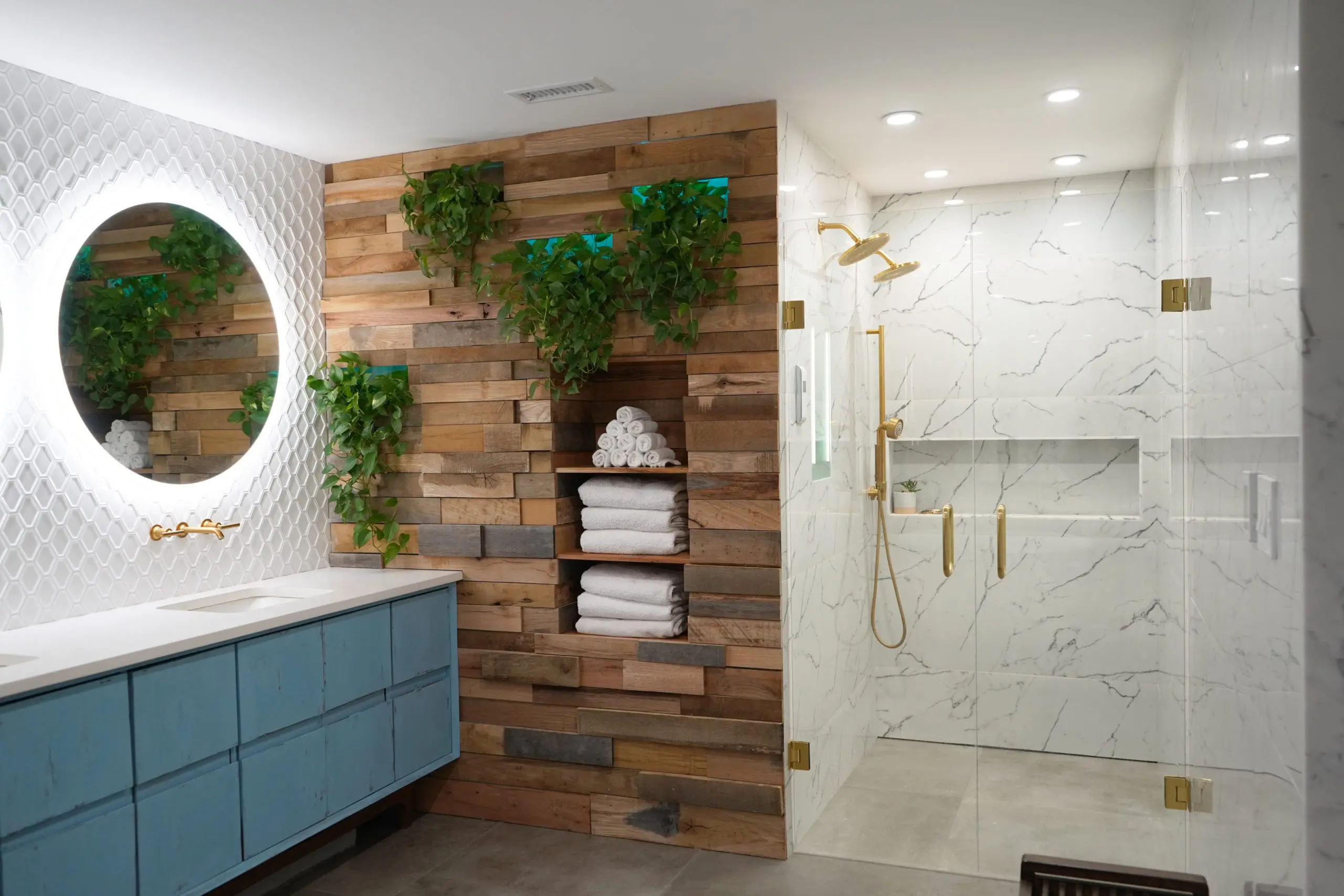
- Design the bathroom with a curbless shower from the outset. Zero-entry showers eliminate the single highest-risk transfer in the bathroom — stepping over a curb — and do not look like medical equipment. They are standard in luxury wellness design and should be standard in any home intended for long-term occupation.
- Keep stairs if you have them and use them daily. The reflexive response to aging-in-place is to eliminate stairs. The evidence-based response is to keep them, use them, and add appropriate handrails and lighting. Regular stair use preserves the lower body strength and balance that reduces fall risk everywhere.
- Reduce chemical burden in the primary living areas. Cognitive function in aging adults is particularly sensitive to neurotoxic inputs. VOCs from synthetic materials, solvents in cleaning products, and pesticide residues accumulate in adipose tissue and the nervous system over decades. Reducing these inputs is a cognitive longevity intervention.
Aging in place done right is not about making a home that accommodates decline — it is about designing a home that actively slows it. The distinction is fundamental. One approach assumes that decline is inevitable and designs for its management. The other assumes that the environment shapes the trajectory of aging and designs to shift that trajectory toward vitality, independence, and function across the full arc of a long life.
Have you thought about how your current home would support you in twenty years — and is there one change you would make today if you were thinking that far ahead?